

New Zealand Isn't a Small Country But a Large Village.
PETER JACKSON - NEW ZEALANDER DIRECTOR
New Zealand
New Zealand is a paradisiacal global anomaly. Words often used to describe the country are beautiful, breathtaking, spectacular, and calm. With its two main islands -- the North island and the South island, New Zealand is a unique experience for anyone who visits. Read each section of this page to learn more about New Zealand's history, current place in the global setting, along with its culture, customs, traditions, and business climate.

New Zealand: The Facts
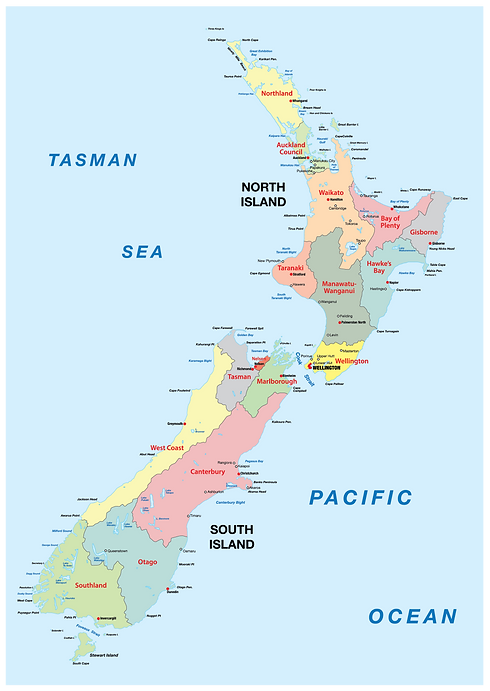
New Zealand is an island country in the South Pacific Ocean about 1,200 miles southeast of Australia. The country is made up of two main islands—the North island and the South island, along with over 700 small islands. New Zealand's population is only 4.7 million, placing it as the 125th most populist countries in the world with a population 1/8 of that of the state of California. The capital city is Wellington and the largest urban area Auckland; both are located on the North Island. New Zealand is a remote land and was one of the last sizable territories suitable for habitation to be populated and settled by humans. Originally part of the Australian colony of New South Wales, New Zealand became a separate colony in 1841 and was made self-governing in 1852. Dominion status was attained in 1907, and full independence was granted in 1931 and ratified by New Zealand in 1947. New Zealand's economy is based on agriculture and services such as tourism, retail, and wholesale trade. The agricultural sector is the largest industry in the country. Dominant languages in New Zealand are English and Māori.

New Zealand Culture
Personal: I've traveled to New Zealand on two different occasions. Each time, I found the people to be kind, friendly and happy.
Core to the culture of New Zealand are the two dominant races of white Europeans and the Māori. The Māori originated with settlers from eastern Polynesia, who arrived in New Zealand in several waves of waka (canoe) voyages between roughly 1320 and 1350. The Māori arrival predates the European arrival by nearly three hundred years. Today, both races exist together, although the white race makes up the majority of the population at 70.2% and the Māoris make up 16.5%, up from 14.9% in 2013 (stats.govt.nz). The increase in Māori population is mainly attributable to interracial marriage with more of the population now citing Māori heritage.
New Zealand is known for its laid-back culture. New Zealand prides itself on its extraordinarily inclusive and progressive culture. The country was the first in the world to give all women the right to vote and has had several female political leaders (heyexplorer.com 2021).

New Zealand and Globalization
"WE'RE OPEN"
In a speech delivered at the UC Connect public lecture University of Canterbury, by the Secretary to the Treasury of New Zealand, Gabriel Makhlouf, the secretary stated, "New Zealand is considered a relatively open economy. We have very low tariffs relative to most countries, so it is relatively easy to trade with us. Some non-tariff barriers do exist, particularly focused on biosecurity for understandable reasons. We do less well on attracting foreign direct investment: in 2011 New Zealand only ranked 71st globally on UNCTAD’s measure of a country’s potential for attracting FDI [2]. (In fact, only 6 countries out of 57 surveyed by the OECD had more restrictive FDI regimes than New Zealand (treasury.govt.nz 2017).
New Zealand relies heavily on it's relationship with neighboring Australia relative to trade. In 2017, Australia made up 18.1% of total New Zealand exports, was the country's biggest source of capital investment, and was the second biggest destination for overseas investment. Again quoting Makhlouf, this time focused on the New Zealand-Australia relationship, "If you want to see evidence of the advantages of free trade, of interconnectedness and of globalization, well it’s on our doorstep" (treasury.govt.nz 2017).
New Zealand has to be open. With only 4.7 million people it can't scale to produce all the goods and services it needs to thrive. Additionally, being an island nation, remote from others, means it must rely on imports. And without the import of goods from other nations, a lack of competition would surely drive up prices for consumers.
But this openness wasn't always true of New Zealand. Huge economic reforms came in the 1980's. The previously heavily regulated economy was transformed. Many government departments were corporatized and restructured into commercially oriented organizations, some of which were then sold to private investors. A public service position was no longer a "job for life". The financial market was deregulated and controls on foreign exchange were removed (nzhistory.govt.nz 2021).
The globalization impact of Covid-19 on every country in the world is evident. New Zealand's response to the virus has been very interesting. The country began implementing its pandemic plan in earnest in February of 2020, which included preparing hospitals for an influx of patients. They also began instituting border-control/travel ban policies to delay the pandemic’s arrival. They went into a countrywide lockdown on March 26, 2020. After 5 weeks, and with the number of new cases declining rapidly, New Zealand moved to Alert Level 3 for an additional 2 weeks, resulting in a total of 7 weeks of what was essentially a national stay-at-home order. The results were astounding. The island country declared the pandemic over in approximately 100 days. To-date, New Zealand has reported 26 Covid-19 deaths amongst it's nearly 5 million people.
New Zealand Communication and Leadership Culture

HOFSTEDE INSIGHTS -- NEW ZEALAND: INDIVIDUALISTIC, MASCULINE, AND INDULGENT
Running New Zealand through the Hofstede Country Insights Model provided some great leanings. The U.S., China, and Russia were selected as familiar comparisons.
New Zealand is an Individualist culture. This translates into a loosely-knit society in which the expectation is that people look after themselves and their immediate families. Moreover, individualists believe in personal freedom and achievement. They believe that you make your own decisions, and that you must take care of yourself (mindtools.com 2021). In the business world, New Zealand employees are expected to be self-reliant and display initiative. Also, within the exchange-based world of work, hiring and promotion decisions are based on merit or evidence of what one has done or can do.
New Zealand is considered a “Masculine” society. Behavior in school, work, and play are based on the shared values that people should “strive to be the best they can be” and that “the winner takes all”. New Zealanders are proud of their successes and achievements in life, and it offers a basis for hiring and promotion decisions in the workplace. Conflicts are resolved at the individual level and the goal is to win.
New Zealand is shown to be a normative country. People in such societies have a strong concern with establishing the absolute Truth; they are normative in their thinking. They exhibit great respect for traditions, a relatively small propensity to save for the future, and a focus on achieving quick results.
New Zealand’s culture is one of Indulgence. People in societies classified by a high score in Indulgence generally exhibit a willingness to realize their impulses and desires with regard to enjoying life and having fun. They possess a positive attitude and have a tendency towards optimism. In addition, they place a higher degree of importance on leisure time, act as they please and spend money as they wish (hofstede-insights.com 2021).
Considering Anthropologist Edward T. Hall's work around high-context and low-context cultures (Merkin. R. 2018), where in high-context cultures the rules of communication are primarily transmitted through the use of contextual elements (e.g., nonverbal communication, status differences, and tone of voice) and are not stated openly; while low-context cultures communicate information primarily through direct communication and interaction, New Zealand would follow other western country norms, such as those found in the U.S., Canada, and Western European countries. and is seen as a primarily low-context communication culture.
Let's Face It... The Only Thing That Really Matters to New Zealanders is Rugby!
New Zealanders live for rugby! Talk about the national team, the All Blacks, seems to permeate every conversation in New Zealand. The All Blacks are the first rugby team in the world to win 500 Test matches and have three Rugby World Cups to their name, winning the title in 2011 and 2015, adding to the inaugural Cup they claimed in 1987.

References
Merkin. R. (2018), Cross-Cultural Communication Theory and Research Overview: In The International Encyclopedia of Intercultural Communication. Medford, MA: Wiley Blackwell.
https://www.history.com/this-day-in-history/british-colonists-reach-new-zealand
https://heyexplorer.com/facts-about-new-zealand-culture/